
9.2.26 Is France Becoming Another Fiscal Flashpoint?
Much of the market's attention in recent weeks has centered on the sharp moves in long-term U.S. Treasury yields. Rising term premiums, concerns about debt issuance, and questions around the sustainability of fiscal policy have all helped drive volatility across the long end of the curve. But rising long-term yields are not just a U.S. story. Across the Atlantic, France is once again showing signs of becoming a focal point for sovereign bond investors.
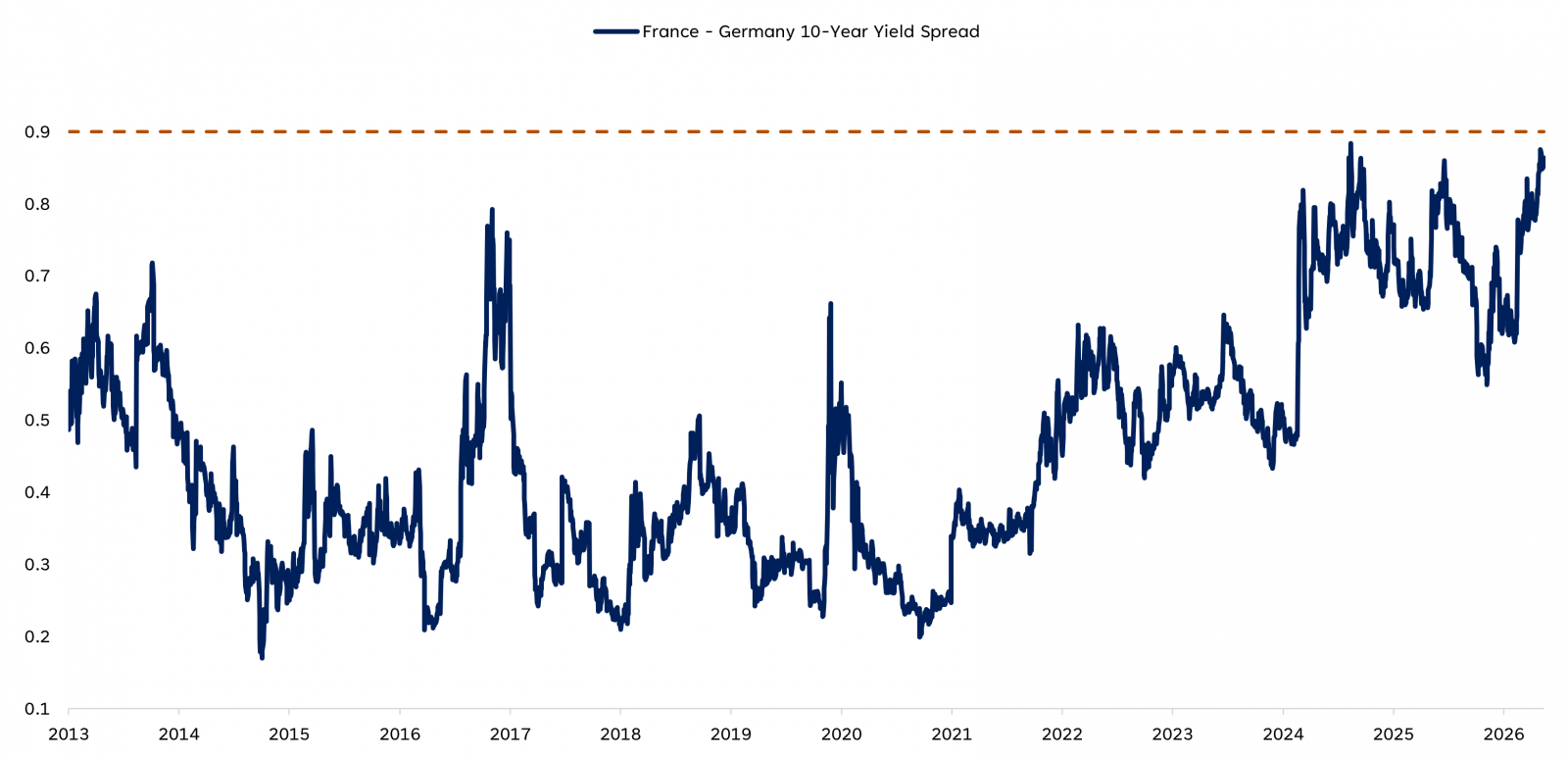
One of the clearest signals is coming from the bond market itself. The spread between French and German 10-year government bond yields has widened recently and is now at levels last seen during the political turmoil that contributed to the collapse of the Barnier and Bayrou governments. Germany remains the euro area's benchmark safe haven, so when investors demand a larger premium to hold French debt relative to German debt, it is often a sign that confidence in France's fiscal outlook is deteriorating.
The source of the concern is relatively straightforward. Markets appear increasingly skeptical that the government's proposed 2027 budget will do enough to place public finances on a more sustainable path. France continues to run a budget deficit near 5% of GDP, well above the European Union's longstanding sub-3% target. At the same time, the political backdrop remains highly uncertain as the country moves closer to the 2027 presidential election. In an environment where meaningful spending cuts or fiscal reforms appear politically difficult, investors are beginning to rightfully question whether deficits could remain elevated for longer than policymakers currently project.
From a market perspective, the most important level to watch is the roughly 90-basis-point (0.90%) spread between French and German 10-year yields. Over the past several years, that level has effectively acted as a ceiling during episodes of fiscal stress. Each time the spread approached those levels, the reaction function of policymakers was to reassure investors and prevent concerns from escalating into something more serious. The question now is whether that ceiling holds once again. If the spread were to break decisively above 90 basis points, it could signal that investors are no longer viewing France's fiscal challenges as just temporary. Instead, markets may begin to reassess the country's long-term debt dynamics more fundamentally. That shift would matter well beyond France. European and global sovereign debt markets remain highly interconnected, and a material deterioration in confidence toward French debt could easily spill over into other countries with weaker fiscal profiles.
French and German Yield Spread is Nearing Critical Levels
- Source: LPL Research, Bloomberg 09/01/26
- Disclosure: Past performance is no guarantee of future results.
More importantly, it could also rekindle concerns about fragmentation within the euro area. One of the defining features of previous European debt scares was not simply rising yields in one country, but the growing divergence between borrowing costs across member nations. While Europe today is in a significantly stronger position than during the sovereign debt crisis of the early 2010s, investors should not dismiss the possibility that fiscal concerns in the bloc's second largest economy could become a broader regional issue. At this stage, the bond market is not signaling a crisis. However, it is sending a warning that merits attention. The recent widening in French spreads suggests investors are beginning to demand greater compensation for fiscal risk at a time when political uncertainty is increasing and budget credibility is being questioned.
For now, markets remain mostly focused on Washington and the U.S. Treasury market. But some of the most important risks are often the ones investors are not watching closely. If French spreads continue to widen and push convincingly through previous stress levels, France could quickly move from a secondary concern to one of the more important macro drivers for global bond markets.
-
Important Disclosures
-
This material is for general information only and is not intended to provide specific advice or recommendations for any individual. There is no assurance that the views or strategies discussed are suitable for all investors. To determine which investment(s) may be appropriate for you, please consult your financial professional prior to investing.
-
Investing involves risks including possible loss of principal. No investment strategy or risk management technique can guarantee return or eliminate risk.
-
Indexes are unmanaged and cannot be invested into directly. Index performance is not indicative of the performance of any investment and does not reflect fees, expenses, or sales charges. All performance referenced is historical and is no guarantee of future results.
-
This material was prepared by LPL Financial, LLC. All information is believed to be from reliable sources; however LPL Financial makes no representation as to its completeness or accuracy.
-
Unless otherwise stated LPL Financial and the third party persons and firms mentioned are not affiliates of each other and make no representation with respect to each other. Any company names noted herein are for educational purposes only and not an indication of trading intent or a solicitation of their products or services.
-
Asset Class Disclosures –
-
International investing involves special risks such as currency fluctuation and political instability and may not be suitable for all investors. These risks are often heightened for investments in emerging markets.
-
Bonds are subject to market and interest rate risk if sold prior to maturity.
-
Municipal bonds are subject and market and interest rate risk and potentially capital gains tax if sold prior to maturity. Interest income may be subject to the alternative minimum tax. Municipal bonds are federally tax-free but other state and local taxes may apply.
-
Preferred stock dividends are paid at the discretion of the issuing company. Preferred stocks are subject to interest rate and credit risk. They may be subject to a call features.
-
Alternative investments may not be suitable for all investors and involve special risks such as leveraging the investment, potential adverse market forces, regulatory changes and potentially illiquidity. The strategies employed in the management of alternative investments may accelerate the velocity of potential losses.
-
Mortgage backed securities are subject to credit, default, prepayment, extension, market and interest rate risk.
-
High yield/junk bonds (grade BB or below) are below investment grade securities, and are subject to higher interest rate, credit, and liquidity risks than those graded BBB and above. They generally should be part of a diversified portfolio for sophisticated investors.
-
Precious metal investing involves greater fluctuation and potential for losses.
-
The fast price swings of commodities will result in significant volatility in an investor's holdings.
-
This research material has been prepared by LPL Financial LLC.
-
Not Insured by FDIC/NCUA or Any Other Government Agency | Not Bank/Credit Union Deposits or Obligations | Not Bank/Credit Union Guaranteed | May Lose Value
-
For Public Use – Tracking: #1168754