
8.4.26 Building Blocks: Personalized Portfolios, Built to Scale
The Quick Take
• Advisors asked for greater customization — so LPL Research built it. Our new building block model portfolios let advisors tailor exposures one component at a time, then combine them for personalized portfolios at scale.
• Crossing $100 billion in model portfolio assets reflects advisor trust — and frees advisors to focus on clients’ most pressing needs.
• The industry is moving the same way: Cerulli reports managed account assets topped $16 trillion, with unified managed accounts (UMAs) growing fastest.
Ask financial advisors what they want from a model portfolio provider and you tend to hear the same answer: institutional-quality research, delivered in a way they can personalize for each client.
For years, that meant a trade-off. Advisors could choose a professionally managed, all-in-one portfolio — or they could build something custom themselves, piece by piece, and take on the work that came with it.
LPL Research’s new suite of building block model portfolios is designed to erase that trade-off, giving advisors customization and flexibility without sacrificing the efficiency of a model framework.
What Are Building Block Model Portfolios?
A building block model is designed to do one job well. Rather than delivering broad exposure across many asset classes in a single package, each building block targets a single asset class or a specific outcome — and each is a purpose-built, professionally managed strategy that can stand on its own.
The new suite spans equities, fixed income, and alternatives, and includes both separately managed accounts (SMAs) and strategies built with exchange-traded funds (ETF) and mutual funds.
Because the models are modular, advisors have options. Use one building block on its own, combine several to construct a core allocation, or layer them onto existing strategies to fine-tune a portfolio at the client level.
The Natural Home: Unified Managed Accounts (UMAs)
Building blocks can work on their own, but they truly shine inside a Unified Managed Account. A UMA consolidates multiple strategies and vehicles — SMAs, ETFs, mutual funds, and individual securities — into a single account managed as one portfolio.
That structure turns a collection of building blocks into a coordinated whole. Advisors gain visibility on a total-portfolio basis, supporting tighter control over asset allocation, factor exposures, and concentration risk, with less unintended overlap.
Tax management can become a structural advantage, too. Loss harvesting can be considered across the entire portfolio instead of scattered accounts, and individual securities within an SMA sleeve can be evaluated in ways a packaged fund cannot — a more holistic approach, delivered efficiently and at scale.
Why Advisors Asked for Single-Asset Building Blocks
The demand reflects how modern portfolios are actually built. Client portfolios have grown more complex — blending active and passive strategies, multiple managers, and a sharper focus on tax efficiency.
In that world, advisors need components they can assemble deliberately, not one-size-fits-all products they have to work around. Building blocks are built to deliver the three things advisors ask for again and again:
Customization: Select the exact exposures a client needs and align a portfolio with individual preferences, styles, and objectives.
Flexibility: Advisors can flex portfolio exposures by adjusting allocations to each building block to meet a client’s needs.
Scale: Deliver personalized, institutional-quality portfolios across a broad client base without building each one from scratch.
The result: institutional-grade customization extended to a far wider range of clients.
The Industry Is Moving Toward Personalization
This shift is bigger than any one firm. According to Cerulli Associates, U.S. managed account assets grew 19.8% in 2024 to reach $13.7 trillion, and industry data through year-end 2025 shows assets surpassing $16 trillion.
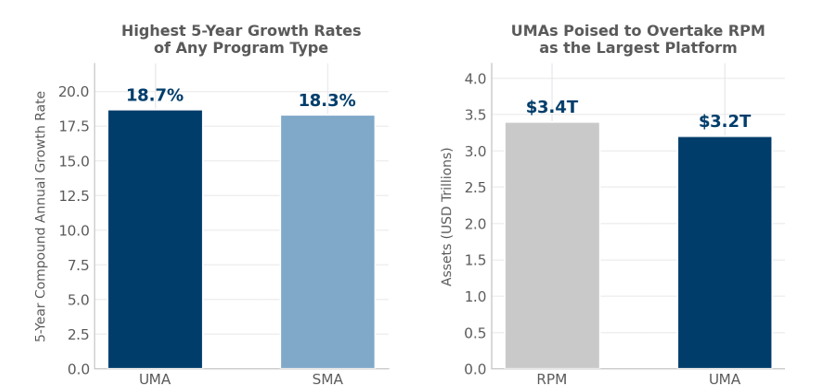
UMA and SMA programs have led that growth, posting the highest five-year compound annual growth rates of any program type — roughly 18.7% for UMAs and 18.3% for SMAs.
Unified Managed Accounts: The Industry’s Fastest-Growing Platform
-
Unified Managed Accounts: The Industry’s Fastest-Growing Platform. Source: Cerulli Associates, U.S. Managed Accounts 2025. Data as of year-end 2024.
UMAs, in particular, have gathered momentum. Cerulli has reported that UMA programs captured the largest share of net flows of any program type and are positioned to become the industry’s largest platform type — driven by rising demand for personalization and tax optimization, and the consolidation of fragmented platforms into unified offerings. Building block models are built for exactly that environment.
A $100 Billion Milestone — and What It Really Represents
LPL Research recently surpassed $100 billion in model portfolio assets (as of June 30, 2026). We see that number less as a headline and more as a measure of trust — the confidence advisors place in our platform to help oversee their clients’ assets.
That trust matters because of what it makes possible. When advisors can lean on a professionally managed, continuously monitored framework, they reclaim time for the work that only they can do: understanding each client’s goals and tending to their most pressing and complex needs.
In our view, that is the real promise of scalable model portfolios — not just efficient investing, but more room for the client relationship.
The Bottom Line for Advisors
Whether the goal is constructing a core allocation, addressing a specific client outcome, or assembling a customized UMA, the building block approach is designed to help advisors do it more efficiently — backed by LPL Research’s asset allocation insights and ongoing oversight.
The aim is simple: the components to personalize portfolios for a wide range of clients, and the framework to do it at scale — so advisors can spend more of their time where it counts most, with the people they serve.
Frequently Asked Questions
What is a building block model portfolio? It is a professionally managed strategy focused on a single asset class or specific outcome that can be used on its own or combined with others to build a customized portfolio.
How is a UMA different from a traditional model portfolio? A Unified Managed Account holds multiple strategies and vehicles in one account managed as a single portfolio, enabling holistic oversight and portfolio-wide tax management.
Why are UMAs growing so quickly? Cerulli attributes UMA growth to rising demand for personalized portfolios and tax optimization, plus the industry’s consolidation of separate platforms into unified offerings.
-
Important Disclosures
-
This material is for general information only and is not intended to provide specific advice or recommendations for any individual. There is no assurance that the views or strategies discussed are suitable for all investors. To determine which investment(s) may be appropriate for you, please consult your financial professional prior to investing.
-
Investing involves risks including possible loss of principal. No investment strategy or risk management technique can guarantee return or eliminate risk.
-
Indexes are unmanaged and cannot be invested into directly. Index performance is not indicative of the performance of any investment and does not reflect fees, expenses, or sales charges. All performance referenced is historical and is no guarantee of future results.
-
This material was prepared by LPL Financial, LLC. All information is believed to be from reliable sources; however LPL Financial makes no representation as to its completeness or accuracy.
-
Unless otherwise stated LPL Financial and the third party persons and firms mentioned are not affiliates of each other and make no representation with respect to each other. Any company names noted herein are for educational purposes only and not an indication of trading intent or a solicitation of their products or services.
-
Additional disclosures: There is no assurance that advisory model portfolios are suitable for all investors or will yield positive outcomes. The purchase of certain securities will be required to affect some of the strategies. Investing involves risks, including possible loss of principal. This material is general information only and is not intended to provide specific advice or recommendations for your clients. Advisory accounts may not be appropriate for every investor. A brokerage account may be more appropriate if your client prefers a buy-and-hold strategy.
-
Asset Class Disclosures –
-
International investing involves special risks such as currency fluctuation and political instability and may not be suitable for all investors. These risks are often heightened for investments in emerging markets.
-
Bonds are subject to market and interest rate risk if sold prior to maturity.
-
Municipal bonds are subject and market and interest rate risk and potentially capital gains tax if sold prior to maturity. Interest income may be subject to the alternative minimum tax. Municipal bonds are federally tax-free but other state and local taxes may apply.
-
Preferred stock dividends are paid at the discretion of the issuing company. Preferred stocks are subject to interest rate and credit risk. They may be subject to a call features.
-
Alternative investments may not be suitable for all investors and involve special risks such as leveraging the investment, potential adverse market forces, regulatory changes and potentially illiquidity. The strategies employed in the management of alternative investments may accelerate the velocity of potential losses.
-
Mortgage backed securities are subject to credit, default, prepayment, extension, market and interest rate risk.
-
High yield/junk bonds (grade BB or below) are below investment grade securities, and are subject to higher interest rate, credit, and liquidity risks than those graded BBB and above. They generally should be part of a diversified portfolio for sophisticated investors.
-
Precious metal investing involves greater fluctuation and potential for losses.
-
The fast price swings of commodities will result in significant volatility in an investor's holdings.
-
This research material has been prepared by LPL Financial LLC.
-
Not Insured by FDIC/NCUA or Any Other Government Agency | Not Bank/Credit Union Deposits or Obligations | Not Bank/Credit Union Guaranteed | May Lose Value
-
For Public Use – Tracking: #1150071