
7.15.26 What Is Resource Nationalism and Why Should We Care?
The term “resource nationalism” generally describes the deliberate effort by nation states to assert control over, direct, and secure access to natural resources within their borders or broader spheres of influence. It is rarely just about commodities themselves. Rather, it reflects a deeper strategic impulse where governments begin to view resource endowments as core to national power, economic resilience, and geopolitical advantage. Once that mindset takes hold, it does not remain confined to the resource sector alone. It propagates outward, reshaping policy frameworks, trade relationships, capital flows, and ultimately, the broader macro landscape.
What Regions or Countries Might Benefit?
Resource nationalism is becoming an increasingly dominant force, with governments actively asserting control over natural resources to secure economic and geopolitical leverage. The clear implication of this shift is structurally higher commodity prices, as competition to secure supply intensifies. Beyond commodities themselves, commodity-linked equities — particularly in energy and materials — as well as commodity-exposed regions like Latin America, are poised to be clear and sustained beneficiaries over time.
Is Resource Nationalism Cyclical or a More Permanent Trend?
We view resource nationalism as more of a recurring cycle than a permanent feature of the global economy. During the 19th and early 20th centuries, natural resources were largely controlled by colonial powers and multinational enterprises, leaving resource-rich regions with limited sovereignty over extraction and distribution. This changed after World War II as decolonization enabled newly independent nations to reclaim control over their natural resources. The movement reached its peak in the 1970s, particularly around the 1973 OPEC oil embargo, when resource nationalism became a major driver of inflation, economic growth, and geopolitical outcomes.
Beginning in the 1980s, globalization and market liberalization shifted priorities toward efficiency, free capital flows, and integrated supply chains, reducing the influence of resource nationalism. Around 2020, the cycle turned again as the pandemic exposed supply-chain vulnerabilities, prompting governments to prioritize resilience, security, and control of critical resources over efficiency.
Surge in Export Bans Globally Post-2020
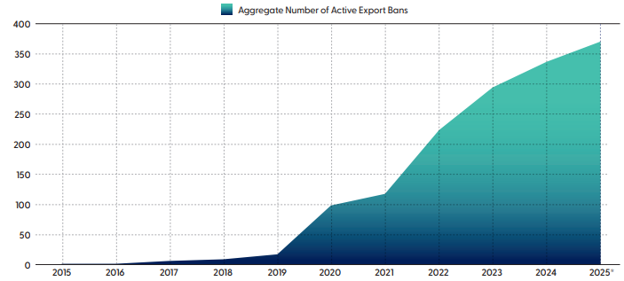
- * 2025 data is estimated
- Source: LPL Research, St. Louis Fed, GTA-NIPO 06/09/26
- Disclosures: The economic forecast may not develop as predicted and there can be no guarantee that strategies promoted with be successful.
What are Some Potential Investment Implications
Resource nationalism typically reemerges as part of a broader shift in the global political economy, rather than through isolated policy actions. As governments increasingly view access to energy, metals, food, and other strategic materials as a national security priority, policies aimed at securing domestic supply can become self-reinforcing and persist for years. For investors, this environment has historically been supportive of commodities and commodity-related equities.
Supply constraints, coupled with greater government involvement in securing critical resources, often strengthen pricing power across the resource complex. As this trend unfolds, exposure to sectors such as energy, metals, and other real assets may become increasingly important for portfolios seeking to navigate a more fragmented, strategically driven global economy.
Find more on information on resource nationalism and other key themes that LPL Research expects to shape markets in the second half in our Midyear Outlook 2026: Policy, Buildouts, and Bottlenecks.
-
Important Disclosures
-
This material is for general information only and is not intended to provide specific advice or recommendations for any individual. There is no assurance that the views or strategies discussed are suitable for all investors. To determine which investment(s) may be appropriate for you, please consult your financial professional prior to investing.
-
Investing involves risks including possible loss of principal. No investment strategy or risk management technique can guarantee return or eliminate risk.
-
Indexes are unmanaged and cannot be invested into directly. Index performance is not indicative of the performance of any investment and does not reflect fees, expenses, or sales charges. All performance referenced is historical and is no guarantee of future results.
-
This material was prepared by LPL Financial, LLC. All information is believed to be from reliable sources; however LPL Financial makes no representation as to its completeness or accuracy.
-
Unless otherwise stated LPL Financial and the third party persons and firms mentioned are not affiliates of each other and make no representation with respect to each other. Any company names noted herein are for educational purposes only and not an indication of trading intent or a solicitation of their products or services.
-
Asset Class Disclosures –
-
International investing involves special risks such as currency fluctuation and political instability and may not be suitable for all investors. These risks are often heightened for investments in emerging markets.
-
Bonds are subject to market and interest rate risk if sold prior to maturity.
-
Municipal bonds are subject and market and interest rate risk and potentially capital gains tax if sold prior to maturity. Interest income may be subject to the alternative minimum tax. Municipal bonds are federally tax-free but other state and local taxes may apply.
-
Preferred stock dividends are paid at the discretion of the issuing company. Preferred stocks are subject to interest rate and credit risk. They may be subject to a call features.
-
Alternative investments may not be suitable for all investors and involve special risks such as leveraging the investment, potential adverse market forces, regulatory changes and potentially illiquidity. The strategies employed in the management of alternative investments may accelerate the velocity of potential losses.
-
Mortgage backed securities are subject to credit, default, prepayment, extension, market and interest rate risk.
-
High yield/junk bonds (grade BB or below) are below investment grade securities, and are subject to higher interest rate, credit, and liquidity risks than those graded BBB and above. They generally should be part of a diversified portfolio for sophisticated investors.
-
Precious metal investing involves greater fluctuation and potential for losses.
-
The fast price swings of commodities will result in significant volatility in an investor's holdings.
-
This research material has been prepared by LPL Financial LLC.
-
Not Insured by FDIC/NCUA or Any Other Government Agency | Not Bank/Credit Union Deposits or Obligations | Not Bank/Credit Union Guaranteed | May Lose Value
-
For Public Use – Tracking: #1140094