
6.2.26 Counting Down to the SpaceX Launch
Interest in the IPO space has skyrocketed in the lead up to the public listing of SpaceX. And for good reason. SpaceX is looking to raise as much as $75 billion in what is expected to be the largest IPO ever, with a projected valuation range of $1.75 trillion to north of $2 trillion. Today we will cover what the company does, what it intends to do, and our key takeaways from the watershed S-1 filing.
SpaceX’s mission is to “build the systems and technologies necessary to make life multiplanetary, to understand the true nature of the universe, and to extend the light of consciousness to the stars.” Those lofty ambitions currently manifest as three businesses: Reusable rockets for space travel, Starlink for connectivity, and xAI’s Grok “truth seeking” frontier AI model (with access to the social media platform X for training data).
Along with serving their existing markets, these three business lines have the combined goal of starting to deploy orbital AI compute satellites working as data centers in space as early as 2028. By lowering the cost of transportation to orbit and leveraging expertise gained by managing the existing constellation of Starlink satellites, SpaceX looks to sidestep existing power bottlenecks restraining the AI race with a solar powered network of satellites. SpaceX management believes AI leadership will be defined by vertical integration of infrastructure and application. In other words, the ability to rapidly scale capacity to support exponential usage growth and frontier intelligence, supported by the belief that more computational resources lead to higher-quality intelligence. Management’s focus on this goal is outlined in their total addressable market (TAM) projections, which skew heavily towards AI enterprise applications powered by AI satellites and mirrors the estimated total market for knowledge work.
SpaceX’s Estimated TAM by Segment
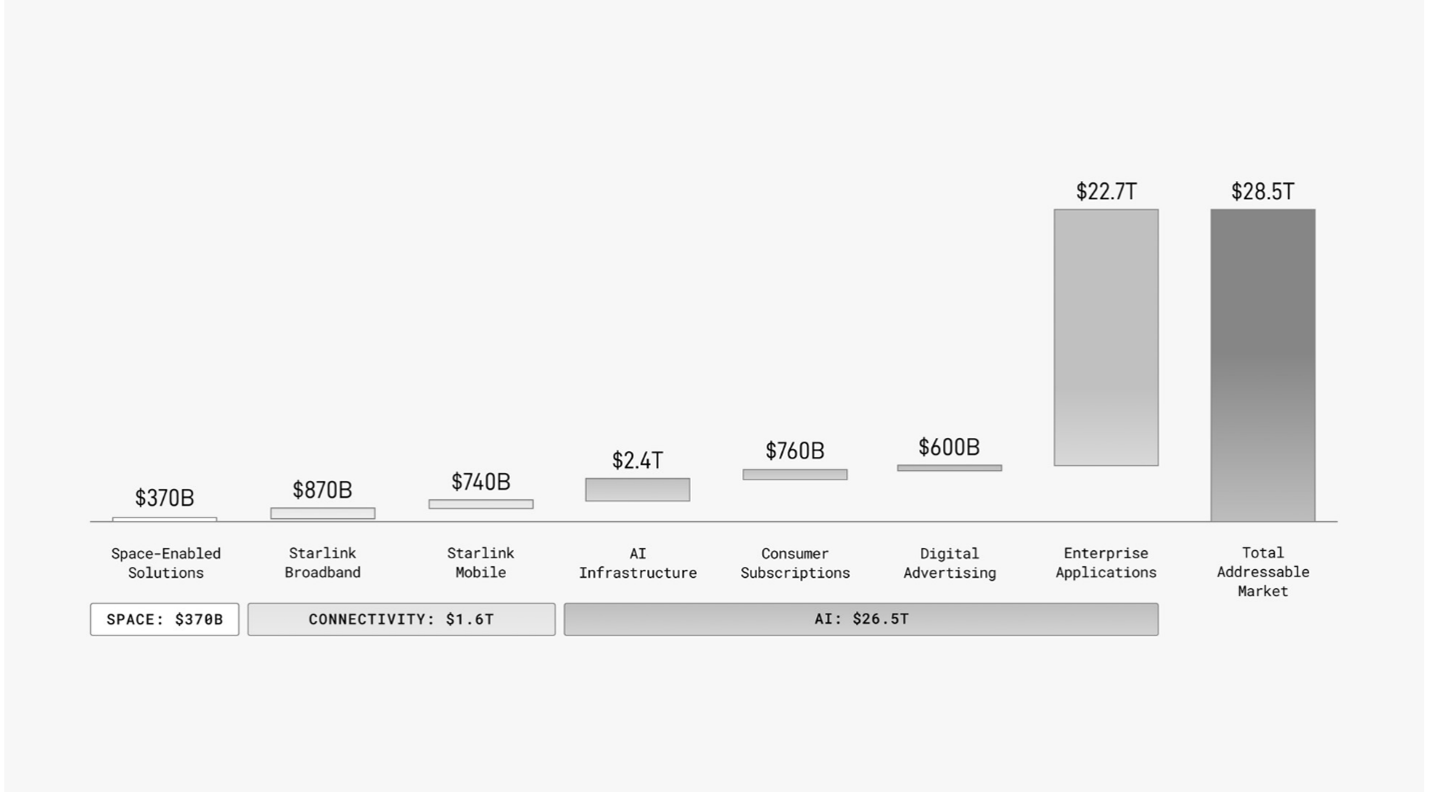
-
Source: sec.gov 5/26/2026
Aiming to achieve something that has never been done on a scale never seen by leveraging technology that does not currently exist, comes with some risks. Known risks outlined by SpaceX include needing to increase launch cadence and payload capacity, which is dependent on the successful development of the newest “Starship” rocket at scale.
Other key risks include potential regulatory changes, customer concentration (~20% of 2025 revenue came from the U.S. government), integration of the newly acquired xAI business, costs associated with the development of AI capabilities, potential delays associated with development of new technologies, potential conflicts of interest between SpaceX and other entities owned by or affiliated with Elon Musk, and key person risk.
SpaceX is very much tied to the success of Elon Musk as he is the chief executive officer (CEO), chief technical officer (CTO), and chairman of the board. Musk has complete control of the company and per the S-1 filing, his “leadership, vision, and expertise are critical to the development of our technologies and the execution of our business strategy.” To incentivize execution on key initiatives, the company has granted the founder two batches of performance-based restricted shares so far in 2026. The performance milestones in the first batch of shares include the company achieving certain market capitalization levels and establishing a permanent human colony on Mars with at least one million inhabitants. The second batch has similar market cap milestones, but vest should the company create non-Earth-based data centers capable of delivering 100 terawatts of compute per year. Additionally, SpaceX does not maintain key-person life insurance on Elon Musk.
All of this adds up to a future-focused company with no shortage of opportunities and risks whose size, profitability, and ambitious timelines set it up for a potentially volatile introduction to public markets. We are intrigued by what SpaceX may accomplish in terms of extending humanity’s reach into the cosmos, but an ambitious mission on its own does not necessarily make for a sound company and there are a lot of hopes and dreams baked into the business plan. To SpaceX’s credit, many of these known risks are outlined nicely in the S-1 filing. The world needs ambitious companies pushing the boundaries of what is possible, but the ride between here and the stars may be too turbulent for some.
-
Important Disclosures
-
LPL Financial does not offer access to or purchase of Initial Public Offerings (IPOs)
-
This material is for general information only and is not intended to provide specific advice or recommendations for any individual. There is no assurance that the views or strategies discussed are suitable for all investors. To determine which investment(s) may be appropriate for you, please consult your financial professional prior to investing.
-
Investing involves risks including possible loss of principal. No investment strategy or risk management technique can guarantee return or eliminate risk.
-
Indexes are unmanaged and cannot be invested into directly. Index performance is not indicative of the performance of any investment and does not reflect fees, expenses, or sales charges. All performance referenced is historical and is no guarantee of future results.
-
This material was prepared by LPL Financial, LLC. All information is believed to be from reliable sources; however LPL Financial makes no representation as to its completeness or accuracy.
-
Unless otherwise stated LPL Financial and the third party persons and firms mentioned are not affiliates of each other and make no representation with respect to each other. Any company names noted herein are for educational purposes only and not an indication of trading intent or a solicitation of their products or services.
-
Asset Class Disclosures –
-
International investing involves special risks such as currency fluctuation and political instability and may not be suitable for all investors. These risks are often heightened for investments in emerging markets.
-
Bonds are subject to market and interest rate risk if sold prior to maturity.
-
Municipal bonds are subject and market and interest rate risk and potentially capital gains tax if sold prior to maturity. Interest income may be subject to the alternative minimum tax. Municipal bonds are federally tax-free but other state and local taxes may apply.
-
Preferred stock dividends are paid at the discretion of the issuing company. Preferred stocks are subject to interest rate and credit risk. They may be subject to a call features.
-
Alternative investments may not be suitable for all investors and involve special risks such as leveraging the investment, potential adverse market forces, regulatory changes and potentially illiquidity. The strategies employed in the management of alternative investments may accelerate the velocity of potential losses.
-
Mortgage backed securities are subject to credit, default, prepayment, extension, market and interest rate risk.
-
High yield/junk bonds (grade BB or below) are below investment grade securities, and are subject to higher interest rate, credit, and liquidity risks than those graded BBB and above. They generally should be part of a diversified portfolio for sophisticated investors.
-
Precious metal investing involves greater fluctuation and potential for losses.
-
The fast price swings of commodities will result in significant volatility in an investor's holdings.
-
This research material has been prepared by LPL Financial LLC.
-
Not Insured by FDIC/NCUA or Any Other Government Agency | Not Bank/Credit Union Deposits or Obligations | Not Bank/Credit Union Guaranteed | May Lose Value
-
For Public Use – Tracking: #1114930