
10.7.26 Housing, Jobs Send Mixed Economic Signals
The U.S. economy is handing investors a muddled picture. Housing is stuck, hiring is lopsided, and households feel worse than the jobs data suggest. Add a string of geopolitical shocks and a Federal Reserve (Fed) under new leadership still establishing its reaction function, and the signals markets rely on are harder to read. Investors will have to adjust to this market, where clarity is scarce.
Housing Stays Stuck
Start with housing, where softer demand for new homes should push the median price lower still, especially as mortgage rates climb. The median price of new single-family homes has been sliding. Even so, it remains well above pre-pandemic levels.
The regional split is sharp. Sales in the West and Northeast continue to weaken, in stark contrast to the firmer uptrend in the South. Rising housing activity ripples through furniture, appliances, and home improvement, so the South's strength should support retail spending and related consumer activity across the region.
Mortgage rates soared above 7% in mid-September, and as of October 6, they are the highest since January 2025. That is still short of the October 2023 peak of 8.1%, but with Treasury markets under pressure, it wouldn't be surprising to see rates move higher from here.
The bigger problem is the widening gap between prevailing mortgage rates and the effective rates existing homeowners are paying (a hat tip to Justin Fox at Bloomberg for the framing). Many owners are sitting on cheap loans and have little incentive to give them up. That lock-in effect keeps the resale market starved of inventory, and new-home sales would need to accelerate significantly to fill the void. Residential investment will likely subtract 0.3 percentage points from growth, and housing isn't poised to power expansion anytime soon.
The Lock-In Continues as Mortgage Gap Widens
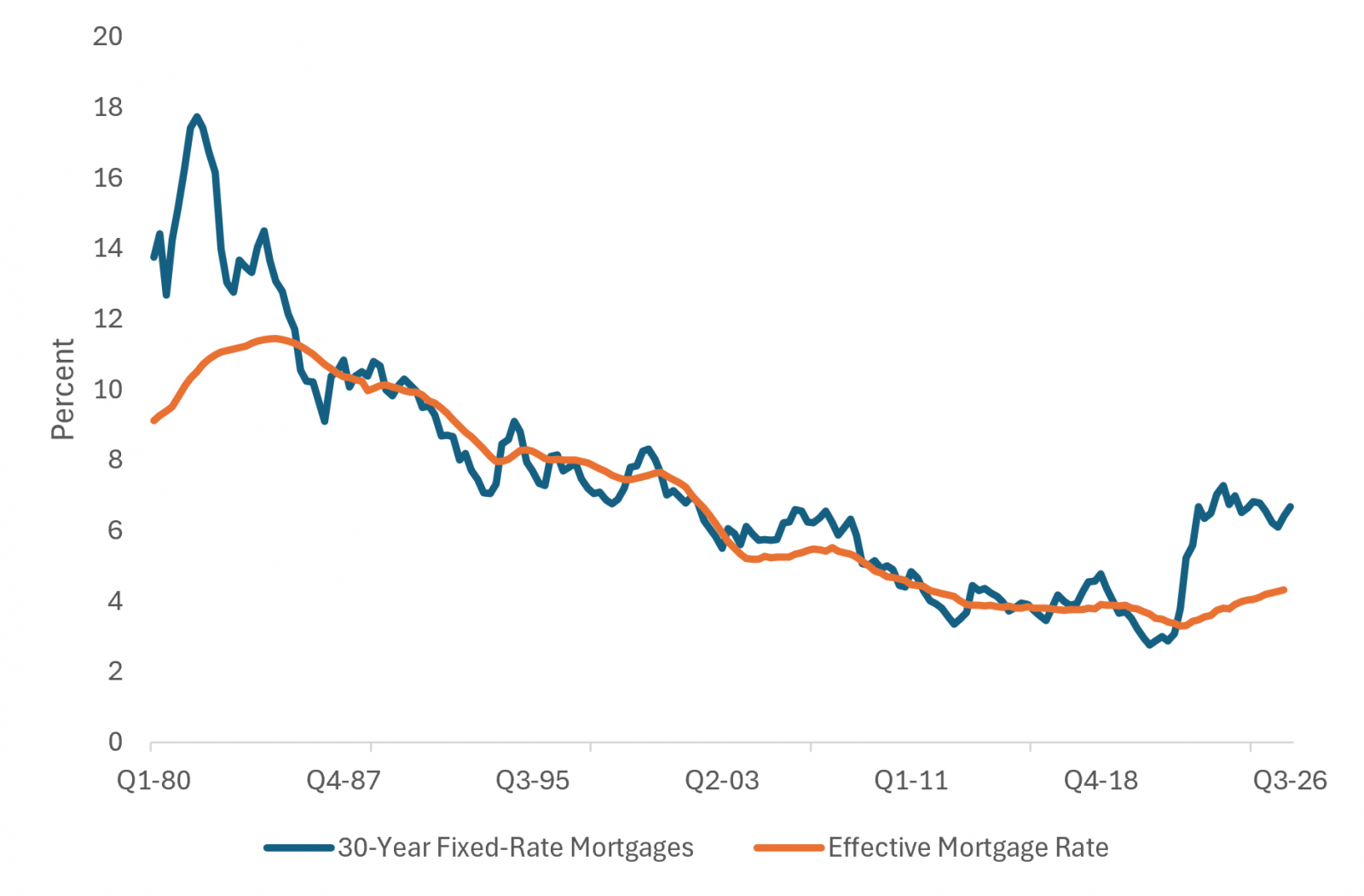
- Source: LPL Research, Federal Home Loan Mortgage Corporation, 10/07/26
A Lopsided Jobs Market
The labor market tells a different story. Demand for workers is concentrated in industries that make things, and less so in those that provide services.
August payrolls got a lift from construction, manufacturing, and healthcare. Information, financial services, and government held back job growth. It is a snapshot of the new economy: the AI buildout is supporting goods-producing sectors, while technological change presses on services.
The unemployment rate ticked up to 4.2%, but the labor market is still operating in a comfortable range. Two wrinkles stand out. First, wages haven't kept pace with inflation in recent months, including the latest reading. That squeezes households on the lower leg of the K-shaped economy, where shrinking real incomes leave little cushion.
Second, labor force growth has stagnated, which lowers the breakeven rate of job growth, the pace needed to hold the unemployment rate steady. Payroll gains are now approaching that breakeven pace. In plain terms, slower hiring no longer guarantees a rising jobless rate, leaving less room for error.
Given the overall softness, the odds of two more Fed hikes this year are shrinking.
Consumers Lose Their Nerve
Then there is the consumer. Confidence fell to 81.9 in September, the lowest since 2014, and August was revised lower. The Iran war has no clear off-ramp, and inflation pressures remain strong. Households say jobs are harder to find, expect weaker income six months from now, and see business conditions deteriorating. Fewer openings and tougher job-hunting have people feeling as gloomy as they did in early 2021.
That doesn't square neatly with the payroll report, and the August JOLTS release offered a counterpoint. The layoffs rate moved lower, a sign employers aren't inclined to purge payrolls. Still, plans to buy a home, a vehicle, or a major appliance have declined from prior months. The consumers captured by the lower leg of the K are likely to pull back on discretionary spending in the fourth quarter, a warning sign for holiday retail sales.
The Bottom Line
Elevated mortgage rates and persistent lock-in continue to limit housing turnover, so housing is unlikely to contribute to growth in the near term, though a stronger South should support consumer spending and regional resilience.
The labor market is bending rather than breaking, and consumers are bracing for a rougher stretch. Confidence is a survey, not hard data, so we don't expect it to change Fed expectations in any material way. If the hard data holds up, the Fed could feel forced to hike just one more time this year.
For investors, the harder task is adapting to the fog. With geopolitical shocks arriving without warning and new Fed leadership still finding its footing, the market is struggling to find clear signals. That argues for leaning on hard data over sentiment, staying diversified, and keeping some flexibility until the picture clears.
- Important Disclosures
- This material is for general information only and is not intended to provide specific advice or recommendations for any individual. There is no assurance that the views or strategies discussed are suitable for all investors. To determine which investment(s) may be appropriate for you, please consult your financial professional prior to investing.
- Investing involves risks including possible loss of principal. No investment strategy or risk management technique can guarantee return or eliminate risk.
- Indexes are unmanaged and cannot be invested into directly. Index performance is not indicative of the performance of any investment and does not reflect fees, expenses, or sales charges. All performance referenced is historical and is no guarantee of future results.
- This material was prepared by LPL Financial, LLC. All information is believed to be from reliable sources; however LPL Financial makes no representation as to its completeness or accuracy.
- Unless otherwise stated LPL Financial and the third party persons and firms mentioned are not affiliates of each other and make no representation with respect to each other. Any company names noted herein are for educational purposes only and not an indication of trading intent or a solicitation of their products or services.
- Asset Class Disclosures –
- International investing involves special risks such as currency fluctuation and political instability and may not be suitable for all investors. These risks are often heightened for investments in emerging markets.
- Bonds are subject to market and interest rate risk if sold prior to maturity.
- Municipal bonds are subject and market and interest rate risk and potentially capital gains tax if sold prior to maturity. Interest income may be subject to the alternative minimum tax. Municipal bonds are federally tax-free but other state and local taxes may apply.
- Preferred stock dividends are paid at the discretion of the issuing company. Preferred stocks are subject to interest rate and credit risk. They may be subject to a call features.
- Alternative investments may not be suitable for all investors and involve special risks such as leveraging the investment, potential adverse market forces, regulatory changes and potentially illiquidity. The strategies employed in the management of alternative investments may accelerate the velocity of potential losses.
- Mortgage backed securities are subject to credit, default, prepayment, extension, market and interest rate risk.
- High yield/junk bonds (grade BB or below) are below investment grade securities, and are subject to higher interest rate, credit, and liquidity risks than those graded BBB and above. They generally should be part of a diversified portfolio for sophisticated investors.
- Precious metal investing involves greater fluctuation and potential for losses.
- The fast price swings of commodities will result in significant volatility in an investor's holdings.
- This research material has been prepared by LPL Financial LLC.
- Not Insured by FDIC/NCUA or Any Other Government Agency | Not Bank/Credit Union Deposits or Obligations | Not Bank/Credit Union Guaranteed | May Lose Value
- For Public Use – Tracking: #1187839