
10.20.26 Could Bad News Mark the Top in Yields?
One of the more interesting developments in the bond market last week, in our view, had less to do with the news itself and more to do with how the markets reacted to it.
My colleagues and I often talk about “news failures” or “news reversals.” These occur when a market receives a piece of information that should, at least on the surface, push prices decisively in one direction, but then either fails to respond as expected or initially moves the way everyone expects before abruptly reversing course. These types of reactions can be important because markets also trade on expectations, positioning, and supply and demand, not simply whether a headline is fundamentally good or bad. When seemingly bearish news can no longer push a market lower, or bullish news can no longer push it higher, it is worth paying attention as it often signals that the news has already been discounted, positioning has become too one-sided, or that the underlying trend is beginning to lose momentum.
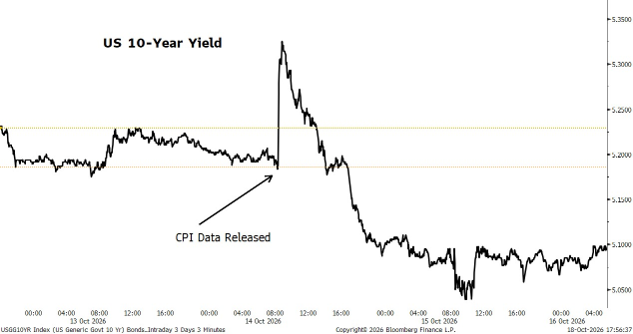
We witnessed a pretty compelling example of that dynamic in the Treasury market last week. Following a firmer-than-expected September Consumer Price Index (CPI) report, the initial reaction was exactly as one would expect. The 10-year Treasury yield jumped sharply immediately following the release as investors digested the prospect that persistent inflation would keep the Federal Reserve (Fed) more restrictive. But then something interesting happened. Yields stopped rising. After the initial spike, the move quickly reversed, and yields started moving lower. Similar reversals developed across much of the Treasury curve. That is notable because the inflation news itself had not suddenly become less concerning. What changed was the market's willingness to continue selling bonds on bearish news. That distinction matters.
U.S. 10-Year Yields Reversed Their Post-CPI Jump
- Source: LPL Research, Bloomberg 10/18/26
- Disclosures: All indexes are unmanaged and cannot be invested in directly. Past performance is no guarantee of future results.
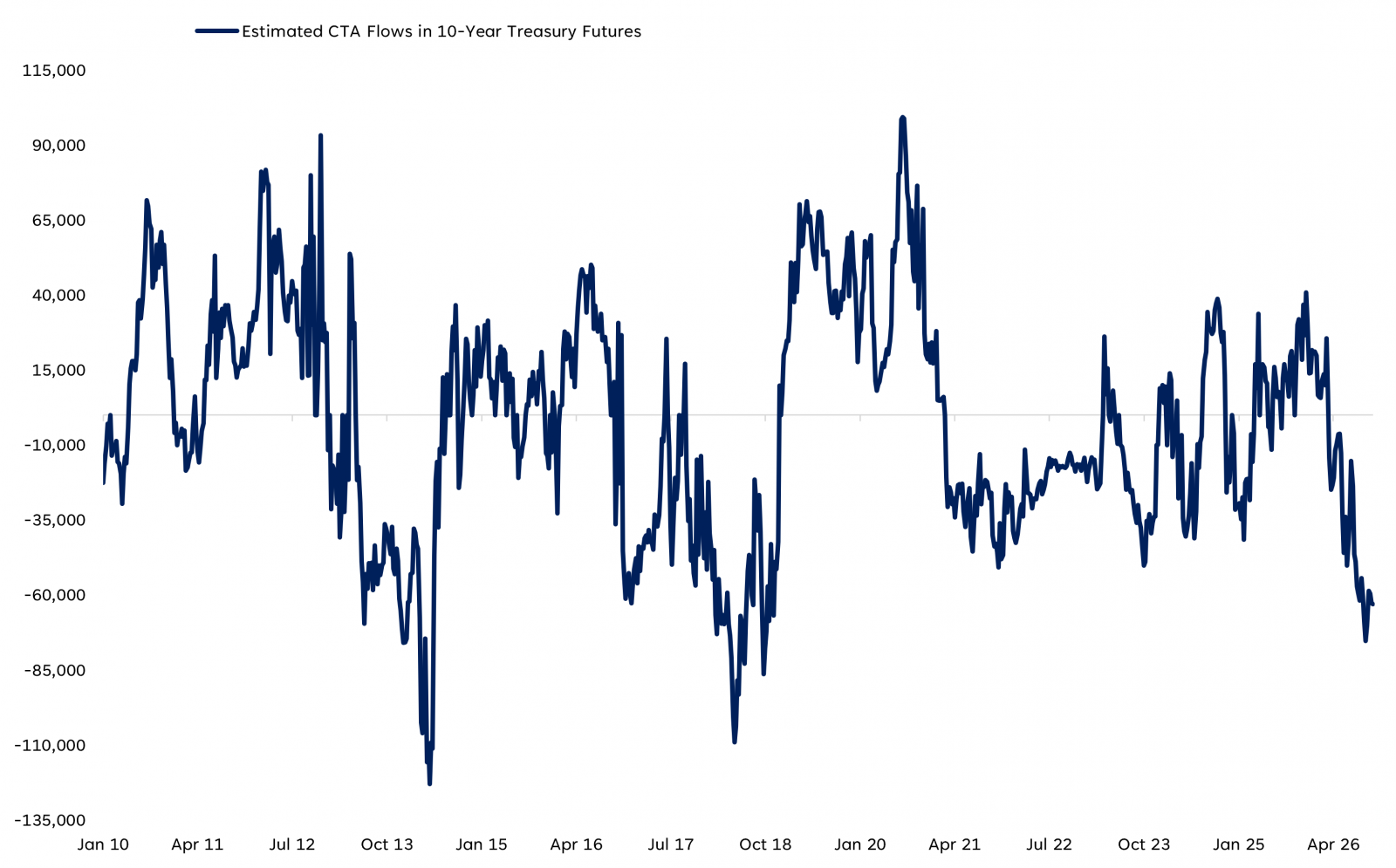
After a sharp and steady rise in yields since the middle of the summer, the Treasury market has recently started showing signs of being stretched. From a technical perspective, bonds had become deeply oversold (yields overbought). At the same time, sentiment toward bonds had deteriorated to unusually pessimistic levels and positioning had become heavily skewed toward higher yields. Measures such as Market Vane have recently reflected some of the most bearish bond sentiment in years, while speculative positioning across the Treasury curve has remained heavily short, as highlighted in the “U.S. Treasury Positioning Has Remained Heavily Short” chart. Put it all together and you have many of the ingredients for a tactical reversal in trend. That does not necessarily mean the peak in yields is in, but when a market stops responding to information the way it “should,” it is often an early sign that something beneath the surface has changed or is at least beginning to.
U.S. Treasury Positioning Has Remained Heavily Short
- Source: LPL Research, VandaXasset 10/18/2026
- Disclosures: All indexes are unmanaged and cannot be invested in directly. Past performance is no guarantee of future results.
That is why we will be closely monitoring the bond market here at LPL Research. Follow-through will be key. A sustained move in the 10-year Treasury yield below the psychological 5.00% area would add credibility to the idea that a more meaningful tactical change in trend is developing. Conversely, a move back through the recent yield highs around 5.36% would suggest last week’s reversal was just a temporary reprieve within the broader trend toward higher yields. For now, we watch and wait, but after months of relentless upside pressure in bond yields, the fact that bad news could no longer make them go up is a clear sign that the trend is finally beginning to lose momentum.
-
Important Disclosures
-
This material is for general information only and is not intended to provide specific advice or recommendations for any individual. There is no assurance that the views or strategies discussed are suitable for all investors. To determine which investment(s) may be appropriate for you, please consult your financial professional prior to investing.
-
Investing involves risks including possible loss of principal. No investment strategy or risk management technique can guarantee return or eliminate risk.
-
Indexes are unmanaged and cannot be invested into directly. Index performance is not indicative of the performance of any investment and does not reflect fees, expenses, or sales charges. All performance referenced is historical and is no guarantee of future results.
-
This material was prepared by LPL Financial, LLC. All information is believed to be from reliable sources; however LPL Financial makes no representation as to its completeness or accuracy.
-
Unless otherwise stated LPL Financial and the third party persons and firms mentioned are not affiliates of each other and make no representation with respect to each other. Any company names noted herein are for educational purposes only and not an indication of trading intent or a solicitation of their products or services.
-
Asset Class Disclosures –
-
International investing involves special risks such as currency fluctuation and political instability and may not be suitable for all investors. These risks are often heightened for investments in emerging markets.
-
Bonds are subject to market and interest rate risk if sold prior to maturity.
-
Municipal bonds are subject and market and interest rate risk and potentially capital gains tax if sold prior to maturity. Interest income may be subject to the alternative minimum tax. Municipal bonds are federally tax-free but other state and local taxes may apply.
-
Preferred stock dividends are paid at the discretion of the issuing company. Preferred stocks are subject to interest rate and credit risk. They may be subject to a call features.
-
Alternative investments may not be suitable for all investors and involve special risks such as leveraging the investment, potential adverse market forces, regulatory changes and potentially illiquidity. The strategies employed in the management of alternative investments may accelerate the velocity of potential losses.
-
Mortgage backed securities are subject to credit, default, prepayment, extension, market and interest rate risk.
-
High yield/junk bonds (grade BB or below) are below investment grade securities, and are subject to higher interest rate, credit, and liquidity risks than those graded BBB and above. They generally should be part of a diversified portfolio for sophisticated investors.
-
Precious metal investing involves greater fluctuation and potential for losses.
-
The fast price swings of commodities will result in significant volatility in an investor's holdings.
-
This research material has been prepared by LPL Financial LLC.
-
Not Insured by FDIC/NCUA or Any Other Government Agency | Not Bank/Credit Union Deposits or Obligations | Not Bank/Credit Union Guaranteed | May Lose Value
-
For Public Use – Tracking: #1194414