
01.08.26 Three Sectors to Watch for Opportunities in Early 2026
In LPL’s Outlook 2026: The Policy Engine, released last month, we highlighted several sectors that are currently rated neutral (essentially guidance to be at a market weight) that LPL Research believes may be poised for strong performance in 2026. LPL Research maintains a positive view of communication services as 2026 begins (the top-performing sector of 2024 and 2025) and continues to monitor technical analysis signals for any potential worrisome signs that suggest that sector may be getting fatigued after leading this bull market since October 2022.
Here are three sectors our Strategic and Tactical Asset Allocation Committee (STAAC) has been neutral on recently that the Committee believes may be poised for an upgrade:
Healthcare
Healthcare remains firmly on our radar for a potential upgrade in early 2026, as it stands to benefit if the market rally broadens. Policy headwinds around drug pricing, the Affordable Care Act, and tariffs have largely cleared, while valuations remain compelling. If the tariffs established under the International Emergency Economic Powers Act (IEEPA) are ruled illegal, which could happen as soon as tomorrow, tariffs paid by healthcare companies (and many other importers) could be rebated — at least until new tariffs can be re-established under a new legal authority. This development could be a short-term positive for the sector.
Another policy development to watch is the Affordable Care Act (ACA) subsidies that were at the center of the government shutdown last fall. A compromise that extends the subsidies could help insurers, hospitals, and other medical facilities.
Relative performance has improved since September 2025, as shown in the accompanying chart, making healthcare a more attractive potential upgrade candidate on a technical analysis basis. The sector remains attractively valued, as it has been for quite some time. Healthcare stocks tend to perform best when the market favors defensive areas of the market, so a rotation away from the more economically sensitive sectors, should it occur, could potentially boost healthcare’s relative performance.
Healthcare Has Been a Relative Outperformer Since September
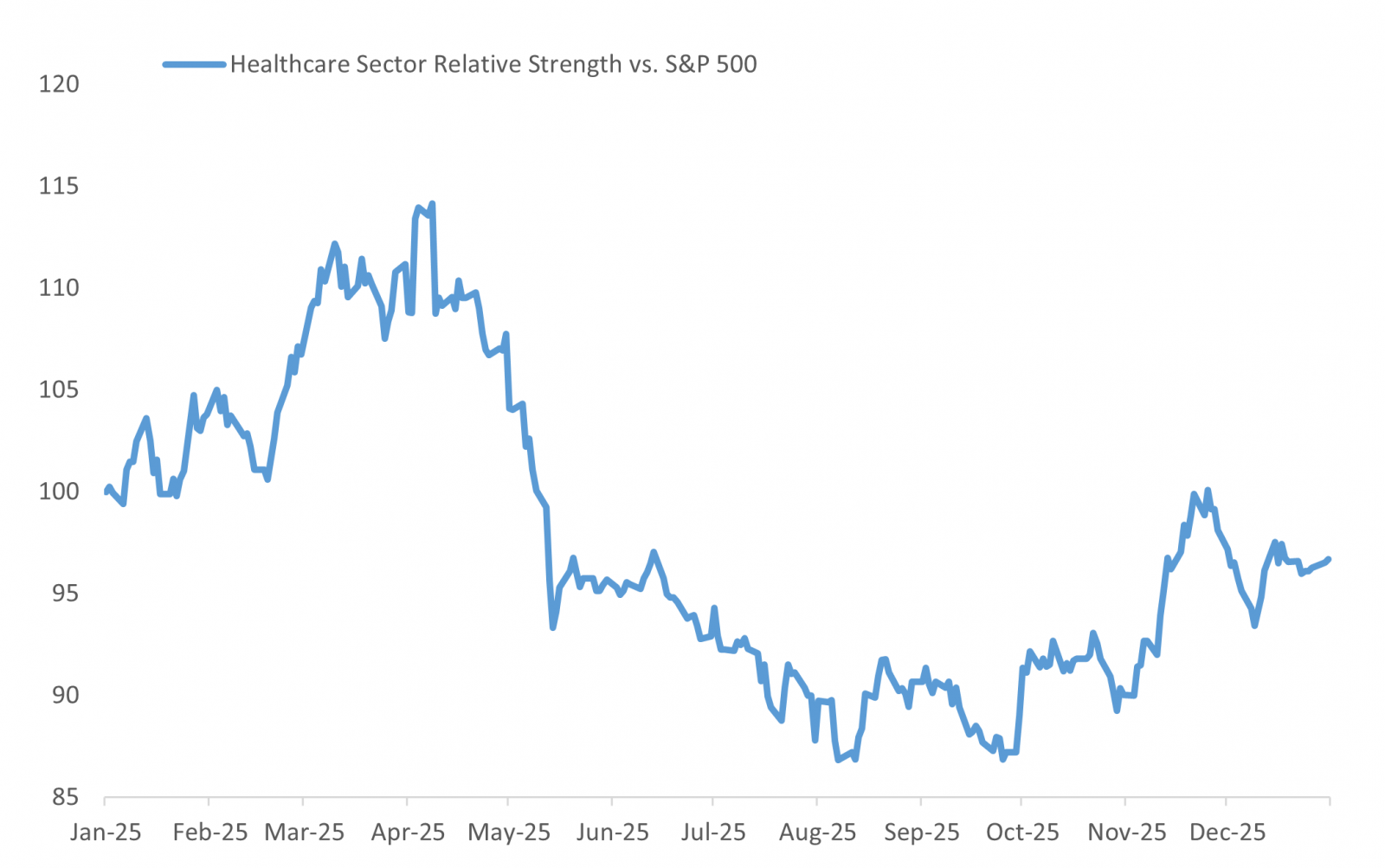
Line graph of healthcare sector relative strength vs. S&P 500 for 2025, highlighting healthcare has been a relative outperformer since September.
Source: LPL Research, FactSet 01/07/26
Disclosures: Past performance is no guarantee of future results. All indexes are unmanaged and can’t be invested in directly. Data series is indexed to 100 on 01/01/25 and goes through year end 2025.
Industrials
Industrials is another neutral sector from STAAC that may be set up well for a potential upgrade in the near term. The sector is a beneficiary of fiscal stimulus and the AI buildout, which together are expected to drive all of the growth in GDP in 2026 (about 2% based on consensus). More specifically, stimulus passed in the One Big Beautiful Bill Act (OBBBA) is estimated to amount to about $130 billion in business tax cuts expected to benefit manufacturing and research and development intensive businesses in 2026, many of them in the industrials sector (and technology too, more on that below).
A similar amount of consumer tax cuts and other consumer stimulus totaling about $135 billion is expected to hit in 2026, according to data from Evercore ISI’s policy research team.
In addition, the roughly half a trillion in capital investments that AI hyperscalers are expected to make in 2026 amounts to more than 1% of GDP. Some of those dollars will go to the industrials sector to build data centers, providing a fundamental tailwind for the sector.
The sector is also positioned to benefit from defense spending. In fact, President Trump has called for a 50% increase in defense spending to $1.5 trillion in 2027, funded by tariffs. That’s too big of a number to get 60 votes in the Senate, but it suggests the trajectory is higher.
Our list of concerns is a short one. The Committee would like to see relative strength improve before considering an upgrade, and valuations are not particularly attractive at a forward price-to-earnings ratio (P/E) of about 25.
We Would Like To See Better Relative Performance From Industrials
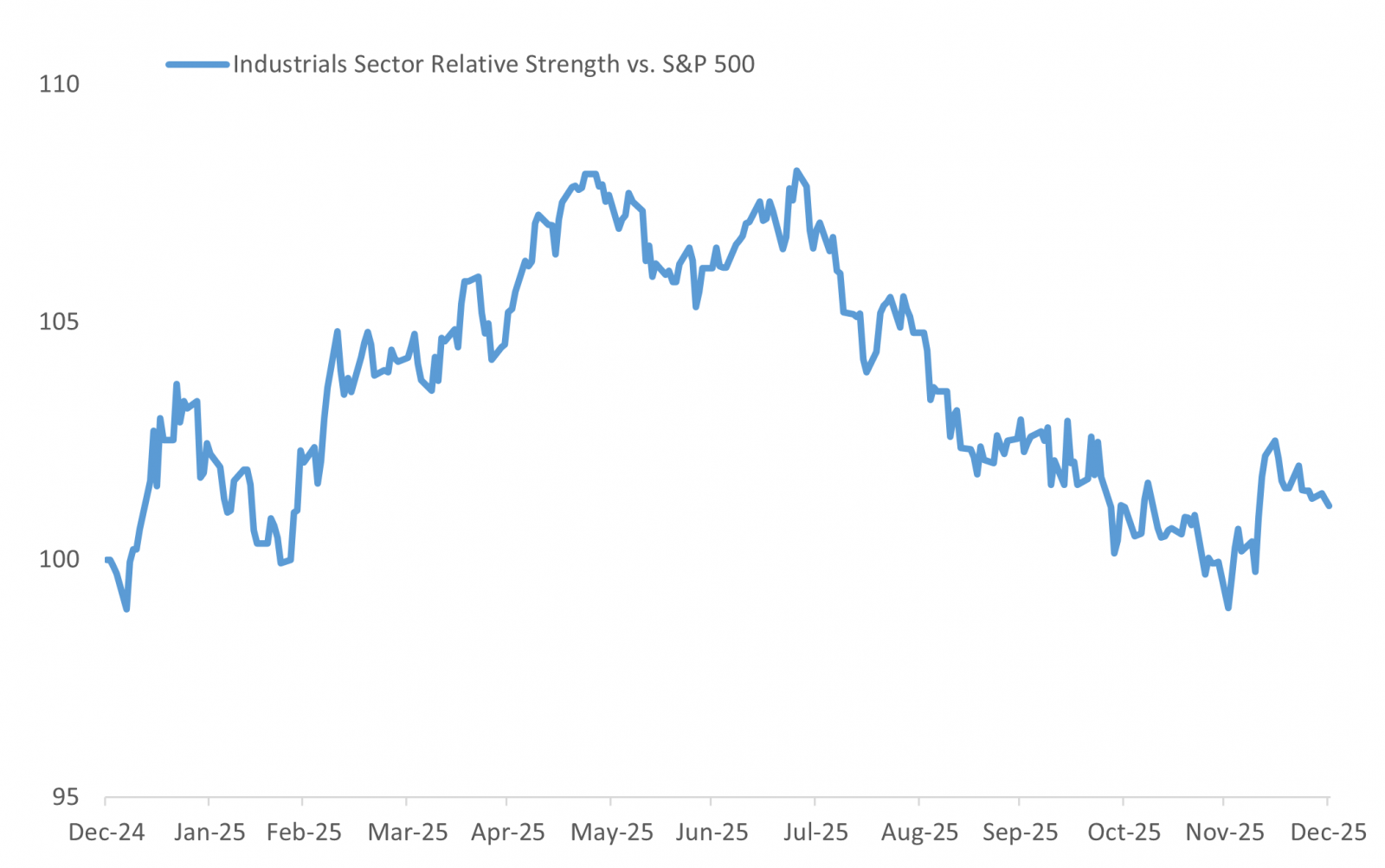
Line graph of industrials sector relative strength vs. S&P 500 for 2025, highlighting LPL Research would like to see better relative performance from industrials.
Source: LPL Research, FactSet 01/07/26
Disclosures: Past performance is no guarantee of future results. All indexes are unmanaged and can’t be invested in directly. Data series is indexed to 100 on 01/01/25 and goes through year end 2025.
Technology
Our last neutral sector that may be poised for an upgrade is technology. At 35% of the S&P 500, a market weight position offers plenty of exposure. And with such strong performance in recent years, it’s natural to be a bit cautious on the sector this far into a bull market. At the same time, market-leading earnings growth on massive AI investment makes the sector a tempting upgrade.
Recent underperformance offers a more attractive entry point, while valuations are actually reasonable when strong earnings are considered. In fact, based on consensus earnings forecasts from FactSet for 2026, the technology sector has the lowest P/E to growth ratio of all sectors. The sector’s price-to-earnings ratio on 2026 estimates is high near 27, but the sector is expected to grow earnings by a similar amount (+28.3%) this year.
So, while the sector’s P/E is in the upper half of its 10-year average, it’s fair to characterize valuations as reasonable. We would like to get an even better entry point before considering an upgrade to overweight, which may have to wait for a broad market pullback of 5% or more.
The Technology Sector's Recent Underperformance May Be Overdone
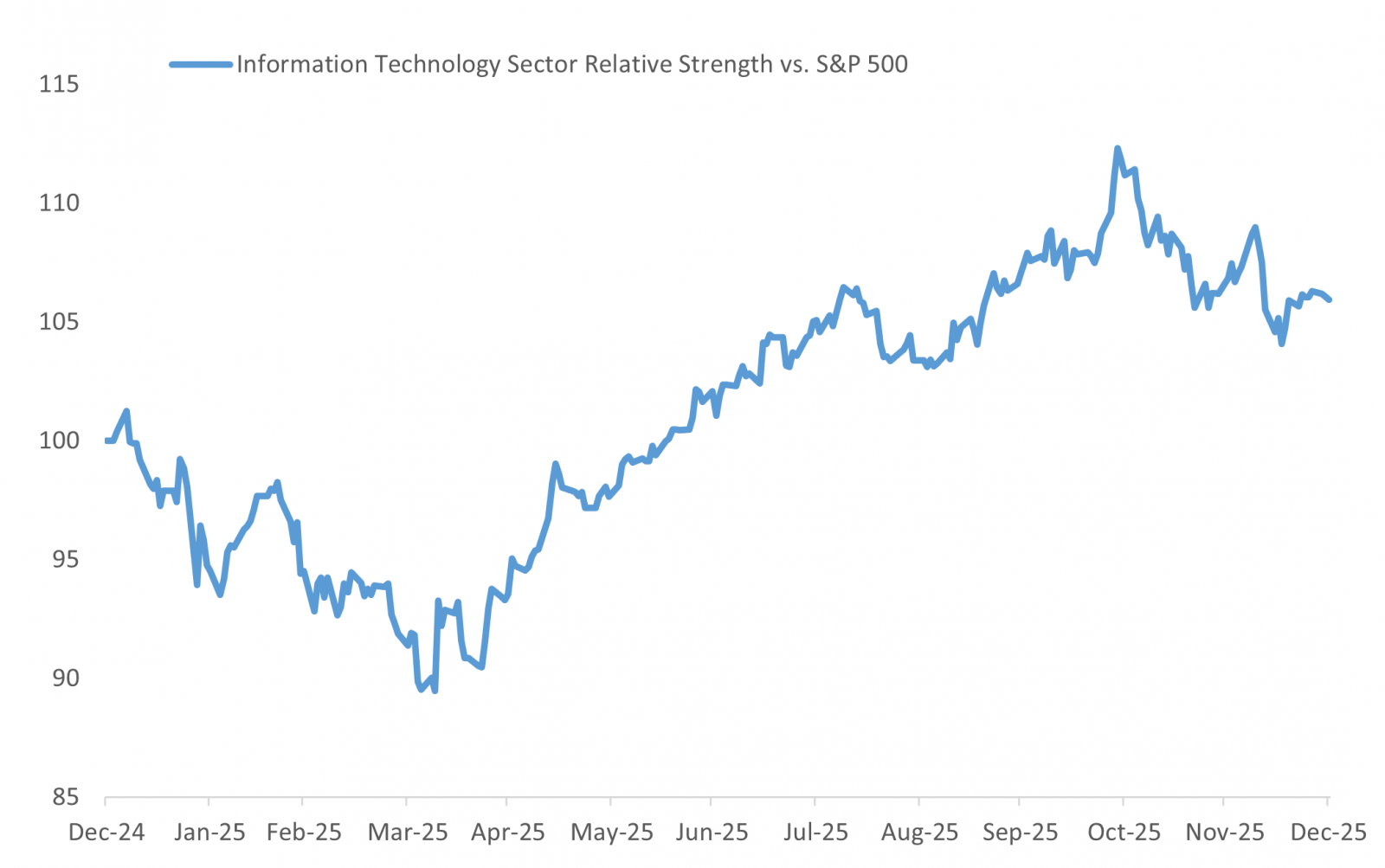
Line graph of information technology sector relative strength vs. S&P 500 for 2025, highlighting technology sector's recent underperformance may be overdone.
Source: LPL Research, FactSet 01/07/26
Disclosures: Past performance is no guarantee of future results. All indexes are unmanaged and can’t be invested in directly. Data series is indexed to 100 on 01/01/25 and goes through year end 2025.
- Important Disclosures
- This material is for general information only and is not intended to provide specific advice or recommendations for any individual. There is no assurance that the views or strategies discussed are suitable for all investors. To determine which investment(s) may be appropriate for you, please consult your financial professional prior to investing.
- Investing involves risks including possible loss of principal. No investment strategy or risk management technique can guarantee return or eliminate risk.
- Indexes are unmanaged and cannot be invested into directly. Index performance is not indicative of the performance of any investment and does not reflect fees, expenses, or sales charges. All performance referenced is historical and is no guarantee of future results.
- This material was prepared by LPL Financial, LLC. All information is believed to be from reliable sources; however LPL Financial makes no representation as to its completeness or accuracy.
- Unless otherwise stated LPL Financial and the third party persons and firms mentioned are not affiliates of each other and make no representation with respect to each other. Any company names noted herein are for educational purposes only and not an indication of trading intent or a solicitation of their products or services.
- Asset Class Disclosures –
- International investing involves special risks such as currency fluctuation and political instability and may not be suitable for all investors. These risks are often heightened for investments in emerging markets.
- Bonds are subject to market and interest rate risk if sold prior to maturity.
- Municipal bonds are subject and market and interest rate risk and potentially capital gains tax if sold prior to maturity. Interest income may be subject to the alternative minimum tax. Municipal bonds are federally tax-free but other state and local taxes may apply.
- Preferred stock dividends are paid at the discretion of the issuing company. Preferred stocks are subject to interest rate and credit risk. They may be subject to a call features.
- Alternative investments may not be suitable for all investors and involve special risks such as leveraging the investment, potential adverse market forces, regulatory changes and potentially illiquidity. The strategies employed in the management of alternative investments may accelerate the velocity of potential losses.
- Mortgage backed securities are subject to credit, default, prepayment, extension, market and interest rate risk.
- High yield/junk bonds (grade BB or below) are below investment grade securities, and are subject to higher interest rate, credit, and liquidity risks than those graded BBB and above. They generally should be part of a diversified portfolio for sophisticated investors.
- Precious metal investing involves greater fluctuation and potential for losses.
- The fast price swings of commodities will result in significant volatility in an investor's holdings.
- This research material has been prepared by LPL Financial LLC
- Not Insured by FDIC/NCUA or Any Other Government Agency | Not Bank/Credit Union Deposits or Obligations | Not Bank/Credit Union Guaranteed | May Lose Value
- For Public Use – Tracking: #845985
Contact us directly should you have questions about this topic.