
01.06.26 Venezuela’s Place in Oil Markets
Key Points:
- Roughly 50% of Venezuela's exports head to the U.S., making this Latin American economy heavily dependent on healthy trade relations with the U.S.
- China only receives 10% of total Venezuelan exports. The remaining top five export partners are Spain (9%), Brazil (6%) and Turkey (5%). 1
- One of the founding members of OPEC, Venezuela is a key player in global supply of crude oil with an economy uniquely exposed to oil markets. Over 77% of Venezuelan exports are petroleum products.2
- As it relates to market impacts, Venezuela produces only 1 million barrels per day (bpd), so short-term supply shocks from the conflict should have only limited immediate effect. For perspective, the U.S. produces over 21 million bpd.
Geopolitical Risks Highlighted by Recent Arrest
Over the weekend, the United States launched a major military operation against Venezuela targeting multiple locations across Caracas and surrounding areas. U.S. special forces captured the self-designated President Nicolas Maduro and his wife, Cilia Flores, flying them to New York to face federal charges on narco-terrorism and drug-trafficking allegations. Simultaneously, American airstrikes hit military sites, and a U.S. naval ship formed a maritime “quarantine” in the Caribbean. While Washington frames this as a law-enforcement mission led by federal authorities, international legal experts and the Venezuelan government have labeled it a breach of sovereignty and international law.
Amid the brewing policy debates surrounding the U.S. administration’s actions, this blog will focus on the economics of international trade and not policy guidance.
Not A Big Player, But…
Venezuela’s economy is deeply intertwined with its trade relationship with the United States. Roughly half of the country’s exports are destined for U.S. markets, according to the CIA, making American demand a critical driver of Venezuelan economic stability. This heavy reliance means that any disruption in diplomatic or trade relations with Washington can have immediate and severe consequences for Venezuela’s fiscal health and foreign exchange earnings.
While China is often perceived as a major economic partner in Latin America, it accounts for only about 10% of Venezuela’s total exports as of 2023.1 Other significant partners include Spain, Brazil, and Turkey, which collectively represent a smaller share compared to the United States. This concentration of trade flows underscores Venezuela’s vulnerability to shifts in U.S. policy and global market dynamics, as diversification efforts remain limited.
As one of the founding members of OPEC, Venezuela plays an important role in global oil markets. Its economy is uniquely exposed to volatility in crude prices, with petroleum products making up more than 77% of its total exports. But it’s a small producer relative to global production. This dependence on oil revenue amplifies the impact of global energy trends and geopolitical developments, leaving Venezuela highly sensitive to both supply-side shocks and demand-side changes in the international energy landscape.
Venezuela is a not a big player in global supply, but its reserves are enormous.
It’s All About That Base
Under the base of that Latin American soil, Venezuela holds the world’s largest proven oil reserves, estimated at around 303 billion barrels, which accounts for approximately 17–18% of global crude resources. These reserves are predominantly located in the Orinoco Belt, where vast quantities of heavy and extra-heavy crude require specialized techniques and upgraded refining capacity — making extraction more technically demanding and costlier than lighter crude types. While these reserves should ideally position Venezuela as a leading energy power, decades of underinvestment, aging infrastructure, and political instability have kept much of this oil underground, preventing the country from fully leveraging that valuable “black gold, [Venezuelan] tea.”
Market Implications
The Venezuelan conflict is expected to have minimal impact on global oil prices because the country plays a relatively small role in overall supply. Venezuela currently produces roughly 1% of the world’s crude, and its exports have been constrained for years by sanctions, underinvestment, and infrastructure challenges. With global production exceeding 100 million barrels per day and major suppliers like the United States, Saudi Arabia, and Russia dominating the market, any disruption in Venezuelan output is unlikely to create significant supply shortages.
Top Ten Oil Producing Countries Share of Total Production and Venezuela Is Not Even Close (as of 2023)
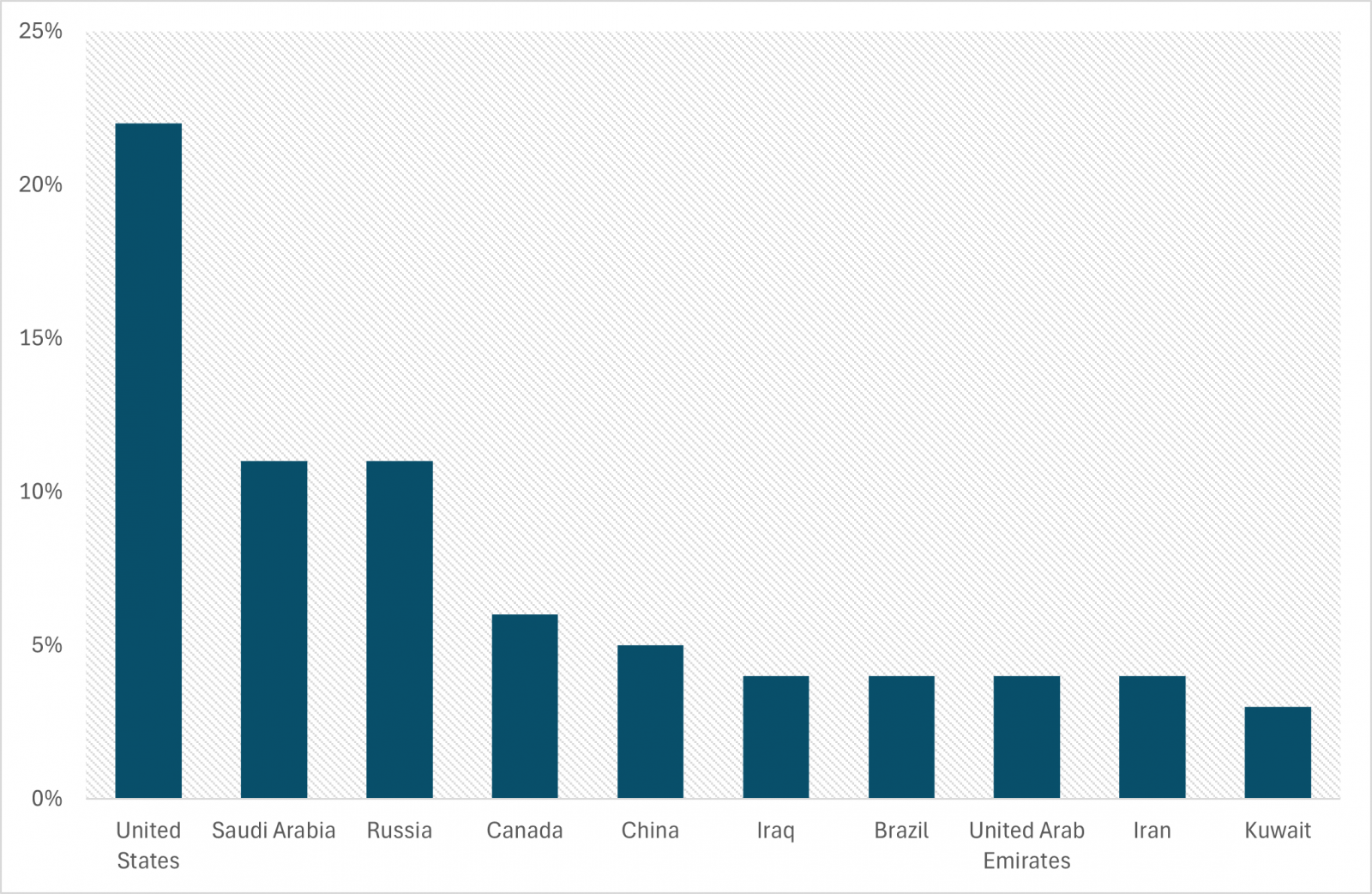
Bar graph of the top 10 oil producers and share of the total world oil production in 2023.
Source: LPL Research, U.S. Energy Information Administration 01/06/26
Furthermore, ample inventories and strong output from other OPEC members and non-OPEC producers provide a buffer against geopolitical shocks, keeping price volatility contained. The more likely scenario is that over time, international firms will successfully bring the large yet untapped Venezuelan reserves to market, creating downside pressure on crude prices.
1 https://www.cia.gov/the-world-factbook/field/exports-partners/
2 https://atlas.hks.harvard.edu/countries/862
- Important Disclosures
- This material is for general information only and is not intended to provide specific advice or recommendations for any individual. There is no assurance that the views or strategies discussed are suitable for all investors. To determine which investment(s) may be appropriate for you, please consult your financial professional prior to investing.
- Investing involves risks including possible loss of principal. No investment strategy or risk management technique can guarantee return or eliminate risk.
- Indexes are unmanaged and cannot be invested into directly. Index performance is not indicative of the performance of any investment and does not reflect fees, expenses, or sales charges. All performance referenced is historical and is no guarantee of future results.
- This material was prepared by LPL Financial, LLC. All information is believed to be from reliable sources; however LPL Financial makes no representation as to its completeness or accuracy.
- Unless otherwise stated LPL Financial and the third party persons and firms mentioned are not affiliates of each other and make no representation with respect to each other. Any company names noted herein are for educational purposes only and not an indication of trading intent or a solicitation of their products or services.
- Asset Class Disclosures –
- International investing involves special risks such as currency fluctuation and political instability and may not be suitable for all investors. These risks are often heightened for investments in emerging markets.
- Bonds are subject to market and interest rate risk if sold prior to maturity.
- Municipal bonds are subject and market and interest rate risk and potentially capital gains tax if sold prior to maturity. Interest income may be subject to the alternative minimum tax. Municipal bonds are federally tax-free but other state and local taxes may apply.
- Preferred stock dividends are paid at the discretion of the issuing company. Preferred stocks are subject to interest rate and credit risk. They may be subject to a call features.
- Alternative investments may not be suitable for all investors and involve special risks such as leveraging the investment, potential adverse market forces, regulatory changes and potentially illiquidity. The strategies employed in the management of alternative investments may accelerate the velocity of potential losses.
- Mortgage backed securities are subject to credit, default, prepayment, extension, market and interest rate risk.
- High yield/junk bonds (grade BB or below) are below investment grade securities, and are subject to higher interest rate, credit, and liquidity risks than those graded BBB and above. They generally should be part of a diversified portfolio for sophisticated investors.
- Precious metal investing involves greater fluctuation and potential for losses.
- The fast price swings of commodities will result in significant volatility in an investor's holdings.
- This research material has been prepared by LPL Financial LLC
- Not Insured by FDIC/NCUA or Any Other Government Agency | Not Bank/Credit Union Deposits or Obligations | Not Bank/Credit Union Guaranteed | May Lose Value
- For Public Use – Tracking: #843905
Contact us directly should you have questions about this topic.